To Sing Frogs Chapter 29c
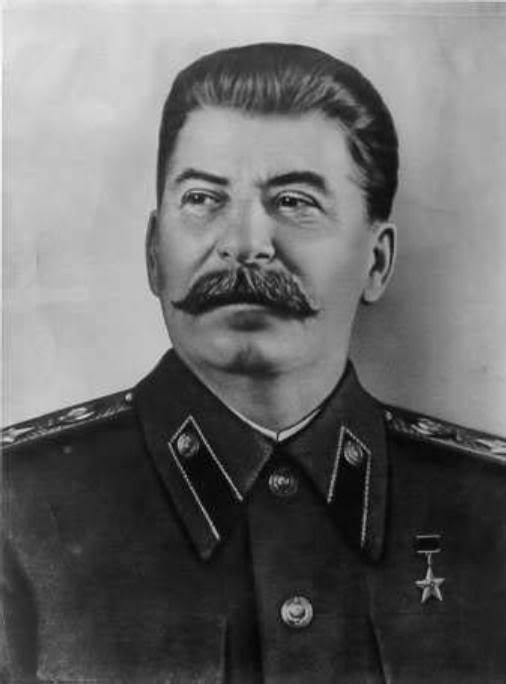 Stalin (His nickname, translated as Man of Steel)
I decided to take Celeste down to the abandoned lobby for a walk and later, some lunch. To my surprise the elevator door opened to swarms of people. They crowded the space to capacity. More than a dozen old smiling veterans were scattered about the marble floor, all adorned in uniforms and medals from yesteryear. The former soldiers all held mixed bouquets. People with bunches of their own identical flowers approached them to add another color to the symbols of thanks.
My daughter and I navigated through the crowd to the revolving door of the hotel. The sidewalk and street was a mammoth duplication of the lobby. The area was still free from cars but people were everywhere. Several makeshift flower kiosks could be seen from the front of the hotel. I carried Celeste to the closest one and bought two dozen long stemmed white roses. There was no shortage of people to give flowers to. A few wandered the streets alone. Others were found on the arms of proud children or grandchildren. Most of them walked in groups of three or four comrades, their brothers and sisters in arms from six decades earlier.
Restaurants had sidewalks loaded with tables where proud countrymen clamored to buy drinks for great patriotic veterans, further pickling their Russian livers.
For a small moment I stood and observed the slow-moving bent war heroes with medals jangling on their chests. For the most part they seemed to be a happy lot as they remembered brave younger days when the fate of the world rested squarely on their capable shoulders. They were glad to be recognized by their countrymen. More importantly, they were proud to have served.
Did they always do the right thing? Had they been flawless in the protection of the endangered? Or had they rescued whom they could and left the others to fate? If so, were they still haunted by names and faces? Were the bravest long gone? Had they failed to survive the war because of their refusal to know when to retreat? If such was the case, what became of the posterity of those who didn’t quit? Had I met them? Had I left them?
What would my retrospective view be when I had experienced eight decades? How would I view the war from my own younger years? There could only be one answer. My self-approval would be mixed, even in the unlikely event that others viewed me as a hero. We are never as forgiving as others when we are left to judge ourselves. Since time began, those who serve have been racked by guilt even when it isn’t merited. It doesn’t seem to matter, to those who punish themselves, that shame is only deserved when we don’t do what we can.
Celeste and I approached the nearest uniformed Dyehdushka. I placed a rose in my daughter’s hand and helped her extend it to the old man. He lifted his head and smiled at the little blonde-haired blue-eyed girl while taking the flower from her grasp. “Spaseeba,” he said in a soft, hoarse whisper. I wondered what things still haunted this man who had witnessed situations that should never have been. Though the position of his cracked lips proclaimed happiness the windows to his soul couldn’t lie. He continued to look at my beautiful little girl until something changed. It appeared as if the purpose of his sacrifice had once again become clear. Light flashed in his eyes. He had willingly paid the enormous price for the hope of future generations. The old man placed his new rose in the bundle held by his other arm. Then he reached out and took my daughter’s soft tiny hand into his old and wrinkled one. He leaned forward and kissed her on the cheek. “Spaseeba,” his old voice echoed while a tear left his eye and tumbled down his leathery cheek. Then he patted me on the arm twice and turned to continue his journey to the end.
Celeste and I hurried from uniform to uniform handing out tokens of appreciation. Each gift was a new experience and met with at least a slightly different response.
We were down to our last rose when I spied the old babushka. A mixed bouquet swung carelessly by her side in one hand and a five-by-seven black and white photo of Iosif Vissarionovich Dzhugashvili was clutched in the other. Stalin. “Man of steel.” Photos of the ruler who poisoned his psychologist for diagnosing him with “typical clinical paranoia,” were not an uncommon sight that morning. Some had fought for the madman, others for friends, family and country. Against my better judgment we approached the old woman. Celeste knew the procedure and held out the flower. We received a smile filled with spaces while she took the rose and stuffed it irreverently with the others in the bunch. The babushka thanked my daughter and then said something to me in Russian. I didn’t understand.
“Nee pah Rooski.”
She grinned from ear to ear. “Ahnglichayen?”
The word sounded like Anglican so I guessed she thought I was British. “Nyet. Amerikanyets.”
The smile left her face and she pointed at Celeste with the corner of her Stalin picture while she squinted suspiciously. “Amerikanka?”
I should have lied. “Nyet. Rooskaya.”
The squint turned to a glare. Then she smiled at Celeste and happily spoke Russian baby talk for a few seconds before returning her angry attention to me.
The old woman barked in Russian and shook her picture of the former bank robber in my face. Then she swung the arm holding the photograph as if she was going to hit my daughter. She did it several times stopping short in each instance. After, she pointed at me with one finger, released from her grasp on the photo. “Nyet!” She did it again. “Nyet!”
Okay, I got it now. The old woman was familiar with several high profile cases of American parents who abused their adopted Russian children. It made sense. At first I just blew it off as misdirected anger from a bitter old woman who didn’t understand the facts. Then I remembered where I had come from. It was I who was not considering the facts. Even if I never abused my own children I neglected and abandoned others. If I saved the ones I was taking home, I was covered in the blood of those I left behind.
The old woman continued to mumble, turning back to shout at me several times while she walked away. I’m convinced if she had a cane she would have beaten me with it.
Go to other sections of To Sing Frogs
Go to John M. Simmons’ blog
Comments
Leave a comment