To Sing Frogs Chapter 32c
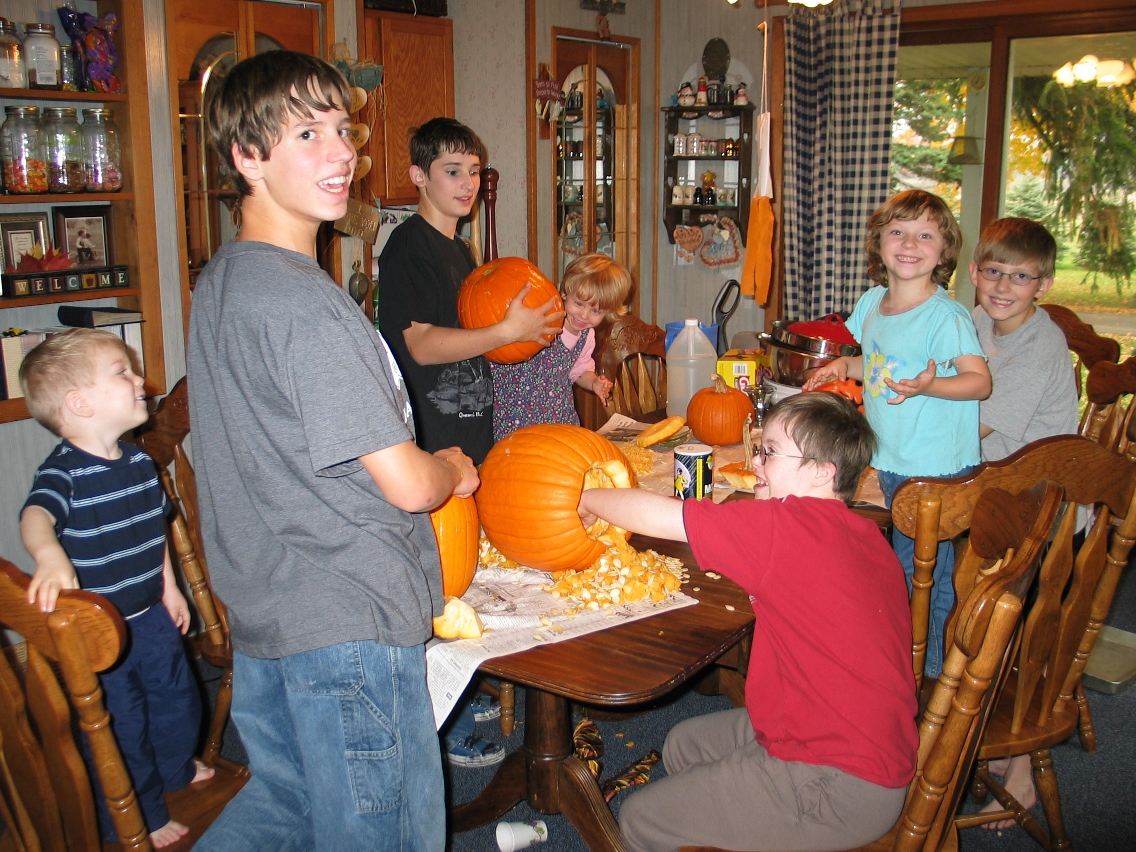 Each of the older boys with their “buddies” carving pumpkins
Sarah’s teachers told us she was charming. Her friends’ parents said she was charming. People at church agreed. No one had ever met a child that was more charming than Sarah.
That was our next red flag. Every book on challenges that might be experienced with children adopted from Russia or Eastern Europe had at least a small section on Reactive Attachment Disorder. The psychologists who wrote about the condition did not use the word “charming” as flatteringly as other people did. To them, being overly charming was a dead giveaway that something might be wrong. Children with RAD are charming for a purpose. They’re parent shopping. These kids have usually had more than one caregiver whom they attached to before being moved on to another. Their young minds had learned that you couldn’t trust caregivers because they will absolutely fail you. It’s only a question of when. The answer—for those who have the disorder—is to have replacement caregivers lined up for when the inevitable happens.
Lots of disorders can be attributed to “nature” rather than “nurture.” RAD is different. It’s caused by a lack of “nurture” and it turns into “nature.” Many of the professionals who specialize in RAD believe that when the child is not cared for by a parent, part of the brain does not fully develop. A more primitive area of the brain takes over. Rather than the brain focusing on building enduring and deep relationships, it turns to survival and immediate gratification. Most of our reading indicated that once the “relationship center” of the brain doesn’t develop, there’s no going back and building it. The situation isn’t without hope. According to studies, other areas of the brain can often be trained to cross over and fill in for parts that aren’t doing their job. In this matter, the condition is not unlike dyslexia. Like any disorder, RAD comes in degrees.
Compared to the horror stories we saw on TV, Sarah’s symptoms were mild. She wasn’t hiding butcher knives around the house or hurting others and pets without conscience.
Sarah’s behavior made more sense to me than it did to my wife. Some would say my reaction would have been different had the shoe been on the other foot. I don’t think so. It was Amy, though, who took the blow.
“Sahlest, yoo de baybee horsey, Aye de geerl horsey ee dees ees mommy horsey. Mommy horsey ees mean ee geerl horsey ee baybee horsey keel mommy horsey.”
“Keel dee mama! Keel dee mama! Keel dee mama!” The two girls used their little plastic horses to pound on a bigger one, finally pulling them back as the larger animal lay motionless on the floor.
“Okaye, now dee mama horsey go een de ground because she no ees nice.”
Celeste was playing with her big sister. Sarah was acting out fantasies. They weren’t just against a demon birth mother who was a danger to their very lives. Amy was mean when she made Sarah do chores. She was mean when she made her eat foods she didn’t like. She was mean when she punished her. Mean was “mean” and Sarah had no concept of purpose or degree.
Amy’s eyes were red and swollen when I came home from work and she told me what she had witnessed.
“I should be more mature than this,” she cried. “I should understand where it’s coming from. It tore out my heart, though. I mean as bad as things were in my home, I never wanted to kill my parents.”
That makes one of us who never wanted to murder them. "Come on, Hon, Your parents hardly gave you third degree burns and then beat you for it. Things were worse for Sarah.”
Amy was abused at home and went into foster care at fifteen. She was the Cinderella in that place, raising the other foster children while the parents partied. (Here’s the part I don’t understand, she even worshipped the foster parents for taking her into their home while they continued to abuse her.) Amy’s birth parents weren’t the only ones I’d fantasized about “putting in the ground.”
My wife had waited and waited for her dream family even though she knew she’d never be the child in such a setting. When Amy finally did get the family she dreamed of, she cherished it. She protected it. She served it like a demanding master and coddled it like a jealous lover. My poor wife couldn’t understand why Sarah didn’t react the same way.
Maybe someone who could see himself stuffing an icepick into the heads of those who abused his wife understands better when a child fantasizes about trampling a person who doesn’t merit it.
Science would say if a brain perceives someone as being a threat to its life, the brain should figure out a way to eliminate the other party. Sarah’s birth mother had been a threat to her survival. My daughter had lived among hundreds of children who came from such mothers. Fathers were almost never in the picture—and therefore safe—even if not useful. That’s why Sarah went after Amy rather than me.
Amy thought if she loved Sarah enough and prayed enough, maybe RAD would go away.
It would be nice. It would also be great if love and prayer were foolproof cures for cancer.
Go to other sections of To Sing Frogs
Go to John M. Simmons’ blog
Comments
Leave a comment