To Sing Frogs Chapter 38b
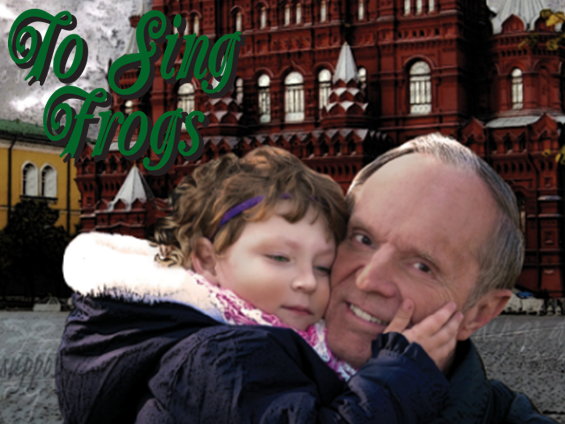
“Djohn!” Yula squealed excitedly before rattling off more words in Russian. We stood in front of a hotel/casino near Vladivostok’s downtown area, on a hill overlooking the waterfront. It was a week after meeting her parents for the first time.
“Yula says she is happy to see you. She wants to know where Amy is,” Anya translated.
“She had to go back home to be with Sarah. Our adoption is finished except for the waiting. I’m staying here until that’s over and then the rest of us will go back home too.”
“Yula wants to know how Sarah is doing. She wants to know when she can talk to her,” Anya said.
I tried to communicate with Yula’s parents but Anya didn’t speak Spanish. I reverted back to a combination of my Portuguese from more than twenty years prior, and to what little Spanish I could remember from high school. Spanish and Portuguese are close enough that speakers of the similar languages can communicate if they work at it hard enough. Still, it had been twenty years. “Let’s see. Okay, umm… Yula quer que ella y Katya pueden falar hablar en telephone. ¿Es posíble?”
“¡Sí! ¡Claro!”
Great. Okay, that means yes, clearly. So far, so good. “Bueno. Tengo amigo que habla Espanol, y outro que habla Russ— Roos— uhhh...” How do you say Russian in Spanish? I grilled myself. Think! Come on, think! “Rusk— Roosk— uhhh...”
“¿Ruso?” Yula’s mother offered.
“¡Sí! ¡Gracias! Ruso. Elles pueden vir para miña casa para ajudar con las mosas y las linguas. ¿Es posíble fazer una data?” I knew I hadn’t used proper grammar, even for Portuguese. I hoped it might be sufficient for them to understand that I could get translators for Russian and Spanish. I also desired to get the point across that I was trying to set a date. It didn’t work.
“Entiendo que tenga traductor. ¿Pero qué es fazer una data?”
Oh man. The verb for “to do or make” must be different in Spanish than it is in Portuguese. I don’t remember this! I feel like Helen Keller, for crying out loud. Where’s the miracle worker when you need her? “Let’s see, ummmm… to do or make, to do or make… Ummm…”
“¿Hacer?”
“¡Sí! ¡Gracias!” I spun to face the man’s voice that came from my left. He had been standing nearby speaking to others in Spanish. “Wait! You understood my English.”
“Yes.”
“You speak Spanish and English and you’re standing there watching me do this to myself?”
The Spanish gentleman laughed. “I thought you were doing pretty well on your own.”
“Would you mind translating?”
“Of course not.”
Within minutes we had arranged a time several weeks in the future for a phone visit. The friendly translator also told me that Yula’s name was now Julia, with the hard “J” from English rather than the soft “Y” sound in Russian or the hard “H” sound the consonant takes in Spanish.
Finally I reached into my bag and removed the gift. Julia squealed. “Do you remember this?” I asked. It was obvious she did.
“She says she does,” Anya translated. Then Julia began to jabber in Russian to her new parents. They looked at me hopelessly so Anya talked to our new Spanish friend in English. Soon he had relayed the story of the bears that Sarah gave to Julia and Marina when she left the orphanage.
I had one more thing I needed to say. “Sarah wanted you to have this bear forever.”
Go to other sections of To Sing Frogs
Go to John M. Simmons’ blog
Comments
Leave a comment