To Sing Frogs Chapter 13a
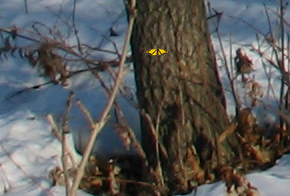 Color in the dead of winter
Chapter 13
Troubled Mind
I waited under a winter-dead cottonwood tree near the portal to other dimensions. A few feet away stood the unassuming door that emptied into lands of fantasy and wealth. The colorless brown bricks of Marina-Grigorievna’s office did not stand out against the monochrome bare trees, angry gray skies, and shifting, shadowy snow.
My attention was drawn to a cocoon hung from a twisted twig that protruded from the trunk of a tree. The wind howled above me and changed its pitch from a low groan to a high whine and finally a scream before returning to its suffering moan. I looked down at the snow drifting around my legs and then back up at the unmoving cocoon. What was nature doing? How could there be a cocoon hanging from a twig in the dead of winter? This was hardly an adequate approach to building a species.
Mesmerized, I stood observing what had to be a dead embryo when it started to slowly squirm. I focused more intently and saw a small witness of color, a tiny hint of yellow amidst the black beneath the translucent shell. I watched in disbelief as the cocoon alternately squirmed and hung motionless until a split began in a slow helix from bottom to top.
The blowing wind howled again, swirling snow that had now drifted up to my knees. The butterfly didn’t hear the wind even though it must have felt the sting of miniature specks of ice in the gusts. The young life knew nothing different and only recognized its instinct to survive. Despite conditions and the unlikely odds for its success, the creature fought against the womb-like shell that could contain it no more. I waited.
Suddenly the top portion of one moist wing broke through the bottom of the cocoon. Its bright Monarch-yellow flash was the only color in the scene. Then the appendage stopped moving and the cocoon hung motionless. I knew a butterfly couldn’t survive in such conditions and I slowly shook my head in disgust at nature’s blunder. I began to move my feet in an effort to free my shoes from the drift that bound me. Meanwhile the velvety triangle flickered to life again. The slit widened and three more bright quarters worked free of the shell in a slow progression of jerky moves.
My head cocked at an angle as I watched the spindly legs of the creature grasp at the only environment they had ever known. Then the bright yellow wings began to dry themselves in long slow-moving arcs. The wind screeched and the colorful sails were caught but the legs held firm. As the gust died down the wings righted themselves and continued to slowly open and close in a dedicated commitment to live.
I wanted to reach out my finger. I knew the Monarch was too young to fear me as an enemy and it would take to my outstretched hand. I held back. Yellow Monarch butterflies are supposed to emerge from their cocoons that hang from protective milkweeds in warm climates. They don’t belong on twigs in the dead of a Russian winter. Even if the only color in this theatre did not belong in the wind-blown-icy environment of a small Russian town it did not belong with me either. So I continued to watch nature’s failure out of pure morbid curiosity—moved—but unwilling to raise a finger.
Soon the wings flapped with more deliberateness and the legs released their grasp one by one. At the same time the wind renewed itself and a gust swept the creature from the cocoon. The rapid flexing of its wings was powerless to direct its body in any way. The butterfly slammed up against the bark of an adjacent tree where it was pinned, motionless. I tore my feet from the drift leaving my American made shoes behind. Then I rushed to see the virtually inevitable results of near-perfect nature when it is in the unusual state of being anything but perfect.
Now kneeling in the snow I leaned forward to look. The quivering legs gripped the coarse bark of the tree while the quaking quarters of yellow wings acted as ropes that would drag the creature to its final resting place. There, pigment could be effectively covered and hidden by oppressive white snow. Color had no place in this dream.
The bright flashing yellow—whether it belonged or not—was the only thing of beauty in the vision. I twisted my knees in the drift and repositioned myself so as to protect the creature from the wind. Once again the dedicated wings began to open and close themselves in a commitment to thrive against all logic. I held out my finger and the fragile creature took hold one leg at a time. Then it looked into my face while continuing to exercise its glowing wings.
Link to other sections of To Sing Frogs
Comments (1)
Leave a comment