To Sing Frogs Chapter 2b
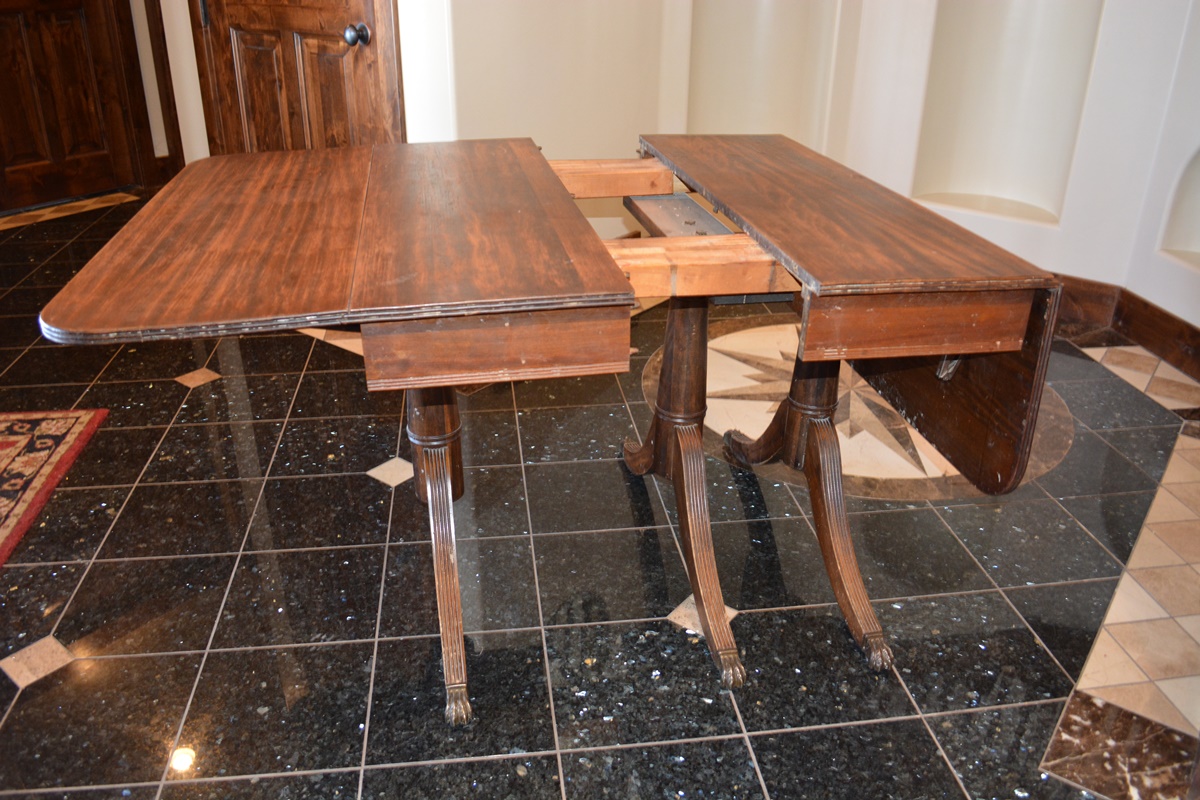 Our “unfinished” kitchen table (as the house which we were remodeling) was used symbolically for our “unfinished” family in the book. Amy found the antique Duncan Phyfe mahogany drop leaf claw foot table at a garage sale.
The woman knew I was referring to an endless list of failures by all of the states in the union so she didn’t even look up while ignoring my question. She pulled a stack of foster parent application documents out of a scuffed-up hard brown briefcase and plopped them down, shaking the table like a California tremor.
You presumptuous wench.
“We’ll begin with official applications and background checks. Be honest because we’ll find out everything anyway. Besides, even if there are police records or other problems, we can usually get past it with the right finesse.”
I couldn’t believe my ears. No wonder Amy’s life in foster care was so bad. The woman continued to speak and her sentences jumbled together and echoed in my head. “Alcoholics can gain sobriety.” “Anger management training may well reform the abuser.” “Government assistance programs are available to provide funding for foster parents who have difficulties maintaining employment.” Then came the kicker, the words that drove all the others from my head. “You would be surprised what has shown up in the records of some people who are now foster parents.”
I don’t believe all foster parents are bad. Some are saints, willfully sacrificing everything they have. Others are slaves, toiling away as indentured servants who work toward freedom and vague promises of future adoption. Oh, the illusiveness of parenthood in such circumstances! The system and its deficiencies also allow far too many abusers to take advantage of the most vulnerable of our society while lining their pockets in the process. My wife’s experience in foster care was proof of that. Amy knew my personality well and understood my complete loathing of a social program responsible for much of her own suffering. She immediately realized she needed to intervene if there was any hope of saving the meeting. “I’m not sure foster parenting is the right choice for us,” she said calmly. “There are children who are adopted through the state without being adopted by foster parents, aren’t there?”
The woman pulled a face and admitted that there was occasionally “an odd case.” Still, my wife wanted her to elaborate on those other options. “We have our hearts set on adoption,” she explained. Amy could sympathize with the state’s shortage of foster parents, but it wasn’t our responsibility to fix their problem. “For some strange reason, we believe that parents outside of China should have the right to decide how and when to build their families.”
Good one, Amy!
“I see.” Social workers love to say; I see. “Well, I have read your initial application. You have quite an interesting history, Mrs. Simmons.” Social workers and psychologists love to use the word “interesting” when anyone else would say “messed up.”
“What do you mean?” Amy asked, guardedly.
“Well, I mean with the abuse, with your going into foster care… It must have been quite an ordeal.”
The observation was so elementary; I was instinctively compelled to respond with a sarcastic allegory about a lack of excrement and a famous English investigator. Once again I hesitated and bit my tongue.
The social worker’s attack accomplished its intent and pushed my wife back on her heels. “It wasn’t easy.” Amy bowed her head in shame. “My dad was pretty bad. It wasn’t just at home. He was notorious. My mom told me that police in Salt Lake questioned him about murders that were attributed to Ted Bundy, later.” My wife continued to look down at her clenched and interwoven fingers as if she was on trial.
“Interesting.”
Messed up.
“He sounds like a pretty bad guy.” The social worker paused.
Elementary, my dear Watson… “Look, Amy’s dad is a creep.” Can we cut the crap? (The filter between my brain and my mouth was still working.) “What does that have to do with us adopting?”
“Nothing, really.” The social worker looked down her nose during the condescending explanation. “Sometimes a history like Amy’s can leave emotional scars that make adoption difficult for the parent, particularly if the child has experienced a troubled past.”
The social worker had successfully convicted my wife for being the victim of a poorly governed social system. I couldn’t understand how that would make us more qualified to be foster parents than adopting ones. It didn’t stop there.
“Did you ever consider yourself an orphan, Mrs. Simmons?”
First Amy raised her ears and one eyebrow. Then she tilted her head. On second thought, those specific actions came only from our dog. Amy’s reaction was akin. “Um, no… Abused, yes, neglected, yes, but not like I didn’t have parents. I guess you could say I can relate, though.” She sat up straight and quickly nodded a couple of times as if she was confident she had provided an adequate answer to an imbecilic question.
“Alright. But wow. Five children. You have four now. Another one will make five!”
I was amazed. At first I thought the social worker was an imbecile. Now she was adding single digits without using her fingers. I shouldn’t have been so quick to judge.
“Well, there’s a lot more paperwork to do. Of course, you realize since you already have four children, it will be a long difficult wait before you adopt another one. That is, unless you decide to go the special needs route.”
Amy was just getting ready to start in with a request for another option. I cut her off. “Been there, done that, bought the tee shirt,” I said while shaking my head. “We already caught our limit of special needs kids.”
“I’m sorry?”


The humor in To Sing Frogs is dry, sarcastic, and sometimes at least a little bit abrasive (some people have called it condescending, but it wasn’t meant to be). That is my real sense of humor and not everyone appreciates it. Humor didn’t exist in To Sing Frogs until halfway through writing it. Then I went back and added it in. One night Amy took me to a movie and told me she “felt like” there was something I needed to learn from the film that would help with To Sing Frogs. The movie was a Quentin Tarantino film called Inglorious Basterds. This film is definitely not a film that Amy would have seen, except for her “feeling.” The film was crass and violent and dealt with horrific subject matter. But every time the subject was about to get overwhelming, a (darkly) humorous scene would give the viewers a break. As we left the movie, Amy apologized for taking me to it, saying there was absolutely nothing about that film that could have helped my book. But her “feeling” was right, as usual. Amy and I used humor to get through the very difficult experience of adopting children. The readers also needed a giggle from time to time to give them a break from frustrations and tears. So, whether you appreciate my sense of humor, or not, that’s how it ended up in the book!