To Sing Frogs Chapter 9a
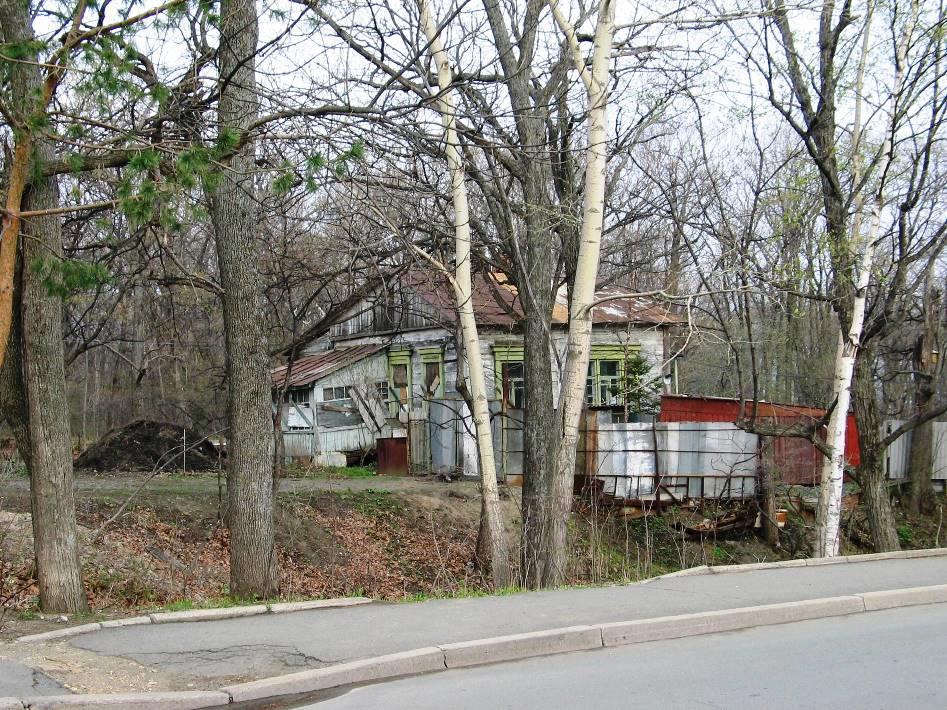 Typical Russian Village House
Chapter 9
Rural Russia
They looked like gingerbread houses, the result of a kindergarten project gone awry. Those crooked buildings appeared to have been built in miniature then tapped by the wand of a demented hag. The result transformed the villages into life-sized props for a strange and scary fairytale.
First glance at the scrolled woodwork and bright paint—where it existed—created a dichotomy. Those features didn’t fit with the dark-brown weathered and worm-holed hardwood that had never been painted. Nor were the futile attempts at beautification consistent with other aspects of the dwellings. Multi-colored rags hung down from where they had been stuffed in cracks as chinking. (Perhaps before the transformation they had originally been created as mismatched smears of frosting.) Now with any luck the cloth plugs would keep drafts in the shacks down to a breeze.
Leaning outhouses and crumbled brick chimneys oozing black coal smoke were the best images for what the communities really were.
Lazy backward settlements provided sharp contrast to traveling in the vehicle. I gripped the door handle with white knuckles as Stass swerved back into his own lane just before the oncoming car blew past. Our coordinator had been trying to pass a freight truck for five minutes and this was the third time his foray into the oncoming lane was abruptly cut short. Stass’s SUV was Japanese, complete with a steering wheel on the right side of the car. Russian traffic drives on the right side of the road. With Stass—who drives faster than most Russian drivers—we spent a good share of time using the other side of the road for passing. The combination of Japanese and Russian driving situations made for toe-curling, teeth-clenching, hand wringing terror. When passing, Stass had to pull clear out into the opposing lane of traffic before he knew if there was an oncoming car. He didn’t use Anya in the opposite front seat for another set of eyes, and she didn’t even offer. She was enjoying the conversation with us, so much of her time was spent looking back. Lucky for her.
As Stass finally completed his nail-biting pass, two oncoming vehicles flashed their lights at him. Maybe he’d take it easy now.
“Did you see that?” Stass asked me.
“Them flashing their lights?”
“Yes. Do you know why they did that?”
“Because you were in their lane?”
Stass looked at me curiously in the rear-view. “No… They know I need to pass. They don’t mind slowing down.”
“Then why did they flash their lights?”
“Watch. You will see.”
Several seconds later we passed a curve on the mountain road. There sat two police cars. One cop remained behind the wheel waiting to give chase. The other stood outside his car pointing a radar gun. “You see now?”
“Sure. Of course.”
Stass went around the next bend and immediately resumed his speed of twice the legal limit. “Are speed limits in the States as unreasonable as they are here?” he asked.
“The limits are definitely higher,” I responded. Stass was right about one thing. A snail could shatter speed limits on Far East Russian highways.
Stass’s driving was living proof of the irony; when boundaries are unrealistic, people observe no limitations. Russia is a case in point.
Apparently Anya doesn’t get car-sick because we were in the perfect storm. Had I myself not been focusing intently out the windshield I would have tossed my cookies.
We wound through canyon roads and past villages filled with more of the peculiar hovels. The edifices easily expressed—in nonverbal terms—that they were apart from society in general and meant to be ignored by all outsiders.
Clothes hung outside “drying” on lines. Freeze drying maybe. There was even the backwardness of an occasional hand-crank well. Each apparatus implemented a wooden bucket to retrieve water for several adjacent cottages. Had I been in the United States I’d have listened for dueling banjos and sniffed the air for moonshine.
Link to other sections of To Sing Frogs
Comments (1)
Leave a comment